lightreads: a partial image of a etymology tree for the Indo-European word 'leuk done in white neon on black'; in the lower left is (Default)
Eternal Darkness

3/5. Account of the history of deep-sea exploration, before turning to the author’s career which includes the discovery of the Titanic’s wreckage, among other things. Way more interested in things than people. He’d be like, ‘let me tell you how this capsule worked that people went half a mile down underwater in,’ and I’d be like ‘okay, but tell me about the maniacs who volunteered for this, because they sound more interesting.’ You can also tell that he is breezing past huge personal slapfights that convulsed the entire field, and on the one hand, he’s not grinding axes, how refreshing. On the other, it’s a bit bloodless.

Interesting stuff, though.
e
lightreads: a partial image of a etymology tree for the Indo-European word 'leuk done in white neon on black'; in the lower left is (Default)
A Promised Land

4/5. First volume of memoir. I thought it would be interesting to read this right after Coates's essays spanning the administration, and I was right. They have different conceptions of race in America; Coates addresses this difference directly when he talks about how disconcerted many of his admirers are when they ask how to solve racial injustice and he says he's not sure it's possible. Obama, by contrast, definitely believes it's possible. This is pretty surprising considering a recurrent theme of this volume is his slowly-growing understanding of the movements that arose after his election, in response to his assumption of power. You'd think, even if only from the vantage of hindsight, this would change his fundamental belief in [fill in a lot of shlocky stuff here about how we're all the same underneath it all]. But it didn't. Or he knows he can't say so. I guess I respect that? Sort of? … Sort of.

Anyway, needless to say it's a great book, and worth reading for a lot of personal insight (and excellent Michelle anecdotes). And parts are absolutely riveting, like the closing section on the bin Laden raid. I found the international politics sections in general to be well worth this hefty book (and expensive! Wow!), as he has a clarity of analysis that is unusual. This book does elide some things, as you might expect – there's a notable absence, among all the charming descriptions of close staff and advisors, of a particular senior individual who it later transpired, and I have bitter personal experience to attest, is a liar and a fraud, and I find it impossible to believe he was anything else in 2009. But in general this book is candid and direct, even about uncomfortable things.

Also, just. What a mind. What a gift he was.
lightreads: a partial image of a etymology tree for the Indo-European word 'leuk done in white neon on black'; in the lower left is (Default)
Early: An Intimate History of Premature Birth and What it Teaches Us About Being Human

4/5. What it says on the tin. An upsetting, fascinating look at prematurity and its prevalence, history, socioeconomic and racial components, and consequences. The prologue is the story of the author's daughter, born at less than two pounds (she survived), what her treatment was like, what it felt like to hold a baby that small against your chest, when even breathing too vigorously on them could decompensate their nervous system. It's a lot. I confused Casterbrook, who I was nursing when I picked up this book, by sniffling onto his fuzzy head.

Because, well, okay. This is a very good book, and I recommend it. But for me, it was (not consciously until later) a sort of purgative. Other people's birth/pregnancy trauma helped me work through some of mine. It's like trauma calisthenics, and it worked, reading this book off and on for a few days, generally while nursing my healthy, thriving full-term one year-old who wouldn't be here today if the cards had landed a little differently. I didn't have a premie (though landing in L&D at 32 weeks is no fun, even when you're 80% sure you're okay) but somehow reading about other people's early births and the ways their babies survived or didn't helped me revisit pregnancy loss, contemplation of late abortion, pregnancy complications ).

Anyway. It's a good book. Also, unrelatedly, by a food writer whose recipes at the NYT I like. Casterbrook is, in fact, a pretty big fan of this soup.

Content notes: Um. Babies die in this book. Not all of them, though. Not even most of them, that's the point. Also, babies receive a lot of medical care, some of it pretty horrific.
lightreads: a partial image of a etymology tree for the Indo-European word 'leuk done in white neon on black'; in the lower left is (Default)
Dreams from My Father: A Story of Race and Inheritance

3/5. I hadn't read this in nearly twenty years, and thought it was time. And that's . . . interesting? Like, this is a book all about growing up as a mixed race kid, and finding and losing different kinds of racial identities, and working as a field organizer in poor black Chicago communities, and going to Africa for the first time. (And also in passing about the drugs he did in high school, LOL. Kid was not planning on running for President with this out there, you guys). It's an extremely personal story of race – that's the entire project. It's about the two sides of his family, and his many half siblings, and the accommodations with themselves and the world they all come to, in different ways. But it is not, even in the chapters about community organizing, a book about institutionalized racism. It's about the extremely personal experience of a thing we're just . . . kind of not talking about. That rings true for a man who would later be dragged hard by segments of the black community for his repeated insistence that all sorts of problems from crime to poverty should be solved in the black family rather than, say, through policy.

But yeah. Good to revisit. I remember how much this book was talked up before his senate run, back when only serious politics nerds knew who the hell he even was. It was revelatory to a lot of people then, many of whom – including me – had never read a book by a black man like this one, about these things. I've read many more since, and this is still a pretty good one.

And also, not for nothing, he was and is a strong, confident writer and, oh yeah, smart as hell. Remember that? It's good to remember.
lightreads: a partial image of a etymology tree for the Indo-European word 'leuk done in white neon on black'; in the lower left is (Default)
Reading Lolita in Tehran: A Memoir in Books

4/5. Memoir of a woman literature professor chased out of formal teaching in Iran after the revolution who held private seminars in her home for seven female students to read banned western books.

This makes a haunting companion to Persian Mirrors: both portraits of Iran written by women, one an American, one a secular Iranian. The smothering force of the regimes restrictions on women is far more urgent and present in this book, to the point where I found it stressful to read. And she has to be so careful in what she says about who – most of the identities in this book are obscured. But she also has such a love of literature, and such a beautiful way of framing her life in the themes of books, that she almost made me care about Fitzgerald, etc.
lightreads: a partial image of a etymology tree for the Indo-European word 'leuk done in white neon on black'; in the lower left is (Default)
Between Silk and Cyanide

5/5. Memoir of the guy who, in his early twenties, ended up running the codes and ciphers division for SOE during the war.

Tremendous. One of those books that dances delicately along that thin line between hilarity and tragedy. Marks is absurdly funny throughout, and an excellent writer. And he's telling the stories of many agents he trained and equipped and briefed who were going to their deaths. Sometimes where Marks knows they will be taken and tortured as soon as they land, and can't say a word. He copes by writing poems (it makes the codes stronger if they are based on poems only the agent knows and that a German couldn't look up). Many of them are funny. Some of them will break your heart.

I hesitate to say that I . . . it's overstating it to say I doubt the veracity here, because I don't. It's more that many people are preternaturally witty, which, well. Fair enough. The truth is, I don't care. This is an extraordinary story that even a scattering of truth – and I do think it's substantially more than that – renders even more remarkable.

One of the best things I've read this year.
lightreads: a partial image of a etymology tree for the Indo-European word 'leuk done in white neon on black'; in the lower left is (Default)
Like a Mother: A Feminist Journey through the Science and Culture of Pregnancy

3/5. This was a rec from someone at NPR and, uh, oh boy yes it sure was a rec from a person at NPR. I kid with love. Anyway, this is about 60% pregnancy/miscarriage/birth/post-partum memoir written by a woman of color, 20% "science," and 20% cultural commentary from a feminist and sort of intersectional perspective (I don't actually give anyone's intersectionality credit when it doesn't include disabled people, and hers doesn't seem to). I came for the science, and ended up enjoying the memoir. I've read a lot of miscarriage and birth stories, and a good writer – which she is – can make something you've heard a thousand times real again. This turned out to be good, because the science parts of this book are supposed to be the things that women just don't know about their bodies, and, uh, I already did? Maybe it's the circles I move in, but these "revelations" about the prevalence of untreated pelvic injury and the specific mechanisms of immune support via breast milk are not news to me. She's not wrong that they should be more widely understood, though, and in general I'm in favor of this movement towards science-based pregnancy and birth practices (though in the case of this book, underpinned with an amount of woo about trusting women's bodies that I wasn't quite ready for).

Basically, it's an NPR rec book.
lightreads: a partial image of a etymology tree for the Indo-European word 'leuk done in white neon on black'; in the lower left is (Default)
The Art of Waiting

4/5. Infertility memoirs are like war memoirs: highly personal, with a bent towards the philosophical when they’re good, tending to be a bit nonlinear in the way memories are when they are formed under traumatic circumstances. It’s just that war memoirs are written by men and win prestigious prizes, and infertility memoirs are written by women and get shelved, inexplicably and it turns out wildly inaccurately, in the “health/diet” section of my electronic library (why?).

This is a pretty good one. It’s frank about the things that don’t get talked about except on infertility blogs, like just how much five years of trying cost, and what the insurance covered and what it wouldn’t. It’s also the sort of book that a thoughtful, writerly person would write after five years of trying and failing and regrouping and trying to move on and starting the adoption process and coming back to try again. So it’s very personal to her, but she also turned her thoughts to other people who came at the same problem from different places, like a gay male couple, and, most painfully, one of the still-living victims of North Carolina’s eugenics sterilization program. The one thing this book is not about, weirdly, is her marriage. I happen to know for a fuckin’ fact that going down this road when it’s long and hard will change your relationship, no question. So it’s an odd omission at the center of this story.

But that’s okay. It’s her war memoir. She gets to tell the parts she wants and keep back the parts she doesn’t.

P.s. They did ultimately get pregnant, if that’s something you need to know before reading.
lightreads: a partial image of a etymology tree for the Indo-European word 'leuk done in white neon on black'; in the lower left is (Default)
Between the World and Me

5/5. Part autobiography, part cultural essay, part history, part intimate family letter.

I am not going to do this justice today (I am sick. Again. Again). So straight out, this is the most extraordinary book I've read in a while. It is a letter to his son, and walks that line of intimacy while also acknowledging the performativity of, you know, being a published book. It is a memoir of coming to intellectual and racial consciousness, and a study of white-on-black violence, and a distillation of several years of his thinking, as will be familiar to his regular readers. I read this very purposefully not trying to analogize it. Like a lot of people, my experience of other kinds of oppression has made it easier to start getting my head around racial oppression, but that only gets you so far and at a certain point, you've got to stop drawing lines and start confronting the thing as it is. I passed that point a while ago, though I didn't realize it in a timely fashion.

So I deliberately read this while working to read it as just itself: a book about race. A book, very specifically, about the violence in racism, the purposeful and systematic destruction of black bodies.* Which worked until it didn't, until about three quarters of the way through when he told a story of responding with sudden, unexpected rage to a white woman's microaggression. And it was just – that moment when you get so angry, and you know, you know your anger will do nothing, that the people around you will do anything to not hear you, and you know your anger is actually counterproductive because of that, because they have made it counterproductive for you to be anything other than silent and accepting, and that just makes you madder, and you are just a tiny cog in the bigger machine that is eating people, this microaggression is one of millions and it doesn't fucking matter, except it's also everything.

Yeah, I don't know, I couldn't just read this book as about race then. Which is a disservice to it. But also why it is so good.

Anyway. Yeah. Read it.

P.s. The audiobook is read by the author, and in my opinion, that adds a great deal to the text.
*There is an argument to be made that racism – the program of destruction of the black body (by police, prisons, poverty) – can be analogized to ablism – the program of destruction of the disabled body (by doctors, institutionalization, and poverty). Go find a news article about a parent killing their disabled child. Go on, they're very easy to find. It happens all the time. Go see if the parent got convicted of murder, let alone even charged. Go read the justifications. Take the temperature of the article. Come away with that sense, unspoken but clear, that it wasn't really murder, that you can kind of understand, how much pressure that parent must have been under, how awful for everyone. Go on, I'll wait. Thus are lives discounted. So yeah, the analogy can be made, and has been I'm sure, by better scholars than I. But I'm realizing more and more that it's of limited help. Violence may be violence, but context is not context is not context.

...

And there's the last book by a man I'll be reading for a year. Hell of a way to go out, too.
lightreads: a partial image of a etymology tree for the Indo-European word 'leuk done in white neon on black'; in the lower left is (Default)
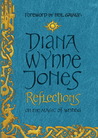
Reflections: On the Magic of WritingReflections: On the Magic of Writing by Diana Wynne Jones

My rating: 3 of 5 stars


Curated collection of essays, speeches and the like. Enjoyable, if repetitious. I talked my girlfriend's ear off about this book for half an hour over dinner, which means I said most of what I wanted to there and don't have much left here. Except that she was a lovely, critical, complicated person. Her analysis of Lord of the Rings actually made me half want to reread it, and that takes doing, trust me. I also identified a great deal with what she said about her writing process: mine, too, is organic and nonlinear, starting with a crystalized notion of a scene or emotional beat and building a story out from there in a 'feeling your way' kind of process. Her conviction that the author must know ten times more about a character than goes into the story is entirely opposite of my practice, but this is not the forum for the line of thinking that set me off on.

But mostly, I enjoyed this glimpse into her social consciousness. Her feminism, in particular, stemmed from a keen observer's eye, but she didn't have a lot of the tools or background to really work her way through it. Hell, a lot of the tools and background didn't exist when she was coming into feminist consciousness. So she could observe the way children's literature encodes maleness as a default as a social artifact, but she couldn't . . . interrogate that, and when she could, later, it was to subvert it by leaning hard on gender stereotypes.

So yeah. Interesting to the completest, the amateur scholar, the biographer (and oh man, how much do I want the excellent, meaty, analytical DWJ bio now?), and the fan.


View all my reviews
lightreads: a partial image of a etymology tree for the Indo-European word 'leuk done in white neon on black'; in the lower left is (Default)
The Midwife: A Memoir of Birth, Joy, and Hard TimesThe Midwife: A Memoir of Birth, Joy, and Hard Times by Jennifer Worth

My rating: 4 of 5 stars


Late-life memoir recalling the author's youth as a midwife in London's East End in the 1950's.

Picked up for the from-the-trenches view of birth (not that much has changed in 60 years when what you're talking about is midwife-assisted, largely unmedicated delivery). Kept for the other 70%, which turned out to be a rich, compelling, complicated, sometimes uncomfortable personal/social history. And for Worth herself, who was smart, and driven, and talented, occasionally racist, and often struggling to find compassion. This is a memoir of someone who was powerfully compelled into exhausting, difficult work that challenged her social comfort zones for reasons she never fully understood, and that resonated with me. As did her explicit recounting of her repeated struggle to see the person under the most abject degradations of poverty. The book is not so well-observed when it comes to ethnocentrism and, in a few startling instances, gendered violence, but there is something about the strength of Worth's writing that makes it all go down as a capsule, her strength and her charm and her painful blind spots.

I want to watch the TV show now.


View all my reviews
lightreads: a partial image of a etymology tree for the Indo-European word 'leuk done in white neon on black'; in the lower left is (Default)
Generation KillGeneration Kill by Evan Wright

My rating: 4 of 5 stars


I had no idea this book would be so funny, but for real, it's hilarious. Also exhausting and enraging and painful. And truly excellent, for the record.

For anyone who doesn't remember, this is the account of a reporter embedded in a marine recon unit during the invasion of Iraq. And by "embedded" I mean he rode in the lead car that was repeatedly the northernmost American presence in Iraq, and the very tip of the invading spear. There are a lot of firefights recounted – or more accurately, a lot of incidences of marines driving purposefully into ambushes – but that's not what's good about this book. What's good are the character portraits, the deft touch Wright has in fanning out people like a hand of cards. He is particularly good at laying out the wildly different individual reactions to violence -- celebratory, num, anguished, indifferent, everything in between. It is a focus on the individual, and I found it rich and thoughtful.

I have a friend who spends a lot of time getting paid to think about how we can prosecute war better. On a technical level, I mean – what can our guys eat, read, learn, what drugs can they take to make them more effective in the field? Judging by this book, almost anything would do, because almost anything would be better than the starvation and disease they work through now.

I do think there is something . . . dishonest is the wrong word, but close. Obfuscating? Maybe. Wright spends most of this book eliding himself flawlessly out of the narrative, to the point where it is jarring when he records some action he took or something he said. He writes most events as if they occurred without him. Which is deeply ethical in a way – this isn't his story. If this were an autobiographical book by a reporter about how hard it is to decide to go off to Iraq for a few months as a civilian and then go home again, I would have rolled my eyes a lot. But at the same time . . . you throw a stone in the river, the course of the water changes. The observed behave differently. And Wright did his best to tell us a story about the river without the rock in it. Wright lived in these guys's pockets for months; he slept in holes dug in the sand with them and drove into bomb blasts with them, and then wrote coolly, almost formally about them. Until the acknowledgements where he calls them by given name for the first time and pulls the curtain back, very briefly, on the depth of the relationships he formed.

He's not obligated to write a personal memoir. And like I said, there is something ethical in his choices. Just . . . a rock in a river changes things.


View all my reviews
lightreads: a partial image of a etymology tree for the Indo-European word 'leuk done in white neon on black'; in the lower left is (Default)
Past Due: A Story of Disability, Pregnancy, and BirthPast Due: A Story of Disability, Pregnancy, and Birth by Anne Finger

My rating: 4 of 5 stars


A lovely memoir of Finger's pregnancy interspersed with recollections of coming into her political identity as a disabled person. How her political activism worked with and against her personal activism of being a disabled woman having a child.

This book was hugely helpful to me in processing things it has nothing to do with. This book was about Finger's planned home birth, and how it went so terrifyingly wrong, and her son's first six months, and the way she had to reconcile her political beliefs with how she viscerally responded to the possibility that her child would be disabled. And I read it, and I thought about the conversation where my sister was talking in a restrained, wistful way about how she still wasn't pregnant, and how even if she could be, there was a pretty big question about whether she could ever safely carry to term. And without thinking even for a second, without stopping at all, I blurted, "I'll carry for you." And I have wondered in some astonishment ever since, through everything (carrying someone else's baby is not as easy as they made it look on Friends, shockingly), why I said it. Not regretting, just -- why? I'm a self-centered career woman with a hugely draining and important job, and I didn't know it back when we first talked, but I was about to go through a couple years of unrelated low-grade personal hell. Dedicating my body and my time and my hopes and my care for months and months to make another person's dream happen is not something I should have volunteered for like that, in that instant of course way. But there it was.

And this book really helped me figure it out. I won't go into the whole damn thing because really, this box is not that big. And also, this book deserves better than my tangent, because it is rich and interesting and very cool in its own right. It's a little sad how much it isn't dated -- there's a weird bit where Finger comments on how new ultrasonography is as a technology, and is it really safe to use on pregnant women? But then nearly every other political moment in the book was painfully real and true. Like when she stood up at an abortion rights meeting and said, "yes, I am with you, I support this cause, but don't you think the way this movement talks about how important it is to abort fetuses with disabilities is really problematic?" And the viciousness and hostility she was met with….yeah. There's nothing dated about that.

Anyway. I highly recommend to many of the mothers of my acquaintance who have thought about their ownership of their bodies in relation to motherhood, or who have considered motherhood to be a political act for whatever reason, or who have looked at their baby and thought, what if you are disabled?

Random pull quotes that helped me in my thinking:

"But I think too that we do our best work politically when we do the work that really tears at us."

"People who aren't disabled never seem less than human to me. But they sometimes seem to be missing a dimension, glib and easy, skimmers over the surface of life, not quite as real."

When I was pregnant I used to get so sick of people saying, "you won't care if it's a boy or a girl, as long as it's healthy." So sick of the assumption that health was all that mattered. But I sometimes used to say, "I don't care if it's healthy or not as long as it's a girl." It's not a joke I would make again.

Health, physical well-being does matter. It's my own internalized oppression that makes me fear having a disabled child, but it's not just that. It's the knowledge that being non-disabled is easier than being disabled. … But to admit that disability and illness are hard doesn't mean that they are wholly negative experiences, meaningless.

I had a child because I wanted something perfect to come out of me. I got just the opposite of what I thought I wanted. I don't believe in God or any version of God, any hand of fate or karma that was out to teach me a lesson. But my child's potential disability did teach me that I don't own my child, he's not an extension of me, not there to reflect me, not there to heal my past.


View all my reviews
lightreads: a partial image of a etymology tree for the Indo-European word 'leuk done in white neon on black'; in the lower left is (Default)
Nothing Was the SameNothing Was the Same by Kay Redfield Jamison

My rating: 2 of 5 stars


Jamison is on my radar as a prominent person with a disability, though she has never explicitly articulated a disabled identity. Her An Unquiet Mind is a hugely important book, politically speaking, and I salute her for outing herself as someone with severe bipolar, and effectively painting a target on her back for religious nutjobs and many of her ablest asshole colleagues in the medical profession. I mean, what the hell do I know about being targeted in wank, compared to that?


This book, though . . . *shakes head*. It’s a memoir of her husband’s loss to cancer. I picked it up for blah personal reasons blah, and also because it was supposed to be about her struggle to distinguish the grief processes from the organic, chemical misfunction of her illness. As a mental health professional and a person with a mental illness, she could really get at this fascinating thing – distinguishing useful emotion from pathological, talking about the biological processes of intense emotion from the inside.


Yeah no. The book is about that for roughly two pages. The rest of the time it’s an extended obituary, and not a very interesting one. By which I mean that I’m glad she wrote it, because I absolutely get how important a process that can be. I just don’t know why it needed to be published.


The book is mostly about her husband, how wonderful he was, how much she loved him. And then he dies, and it sucks. You’d think, hey, grief is universal, but no. this book isn’t about grief, it’s about Jamison delivering a long eulogy to someone she loved that almost none of her readers will know. And it’s all told in this ponderous, stylized, cinematic mode, all ‘and then he dipped the ring in the North Se and put it on my finger.’ Lots of tell, everything was so romantic and intensely meaningful, you know. I’m sure these things actually happened, but the book has this roseate glow of recollection to it that precludes the more complex, the emotionally analytical, the clarity of insight I expect from Jamison.


Like I said: glad she wrote it. She clearly needed to. I just don’t see what anyone else reading it will get from it.


View all my reviews
lightreads: a partial image of a etymology tree for the Indo-European word 'leuk done in white neon on black'; in the lower left is (Default)
Why I Burned My Book and Other Essays on DisabilityWhy I Burned My Book and Other Essays on Disability by Paul K. Longmore

My rating: 4 of 5 stars


Three and a half years ago, before I started law school, I applied to receive services from my state’s vocational rehabilitation agency. VR will sometimes pay the adaptive technology expenses of students with disabilities so it can be financially feasible to pursue higher education. At a very conservative estimate, the access tech I use for school purposes costs upwards of $10,000, and that’s not counting the potential expense of services (such as a live reader in the library if I can’t get electronic access to something in time) which can run from $10 to $40/hour, depending on the complexity and specialty required.


I’d been through the VR rodeo before in a different state for undergrad, so I was kind of prepared. My first meeting with my case manager went something like this:


Oh, wow, you have a doggie – that must be so nice for you to have a friend! Let’s just fill out these forms – tell me every gory detail of your medical history going back twenty-three years. Yes, of course including all test results, experimental surgeries, and anything else not remotely relevant to your educational prospects. Now, do you have a parole officer, because they’ll have to discuss my case. No? Well! Are you sure you want to go back to school? You have a job, after all, why do you want to leave it? [Desire for betterment and career planning not being things that disabled people do, apparently:]. And law school, do you know how hard that’s going to be? Have you really thought about this? Lots of people drop out, you know – lots of people just like you. [The secret code, I assume you guys can crack it:]. Are you sure you don’t have a parole officer?


And then we got into my school of choice, a top-tier, nationally recognized institution I was already accepted to. Why was I going there? Why wasn’t I going to the small local school that had regained (regained, not earned!) its accreditation so recently, it wasn’t even ranked? Did I know that if I went there, VR might consider paying the tiny tuition? How did I know nationally-recognized school was a better school -- I’d just moved here!


I politely suggested that they pay tiny local school’s tuition rates to my school, which was a drop-in-the-bucket, but something, but what I really needed was technology support, so could we talk about that?


It was at that point that there was a stamp put on my file. I don’t know if it was metaphorical or actual, but either way it said something like “noncompliant.” Or maybe “difficult.” Or quite possibly, “uppity.” I never saw a penny of tuition assistance, which I was fully expecting, but neither did I get one scrap of access tech support. And I didn't throw the screaming fit that might or might not have changed that, because I was kind of busy at the time kicking ass and taking names in law school, and racking up debt like no one's business.


This book is about that. That scenario specifically, which is incredibly common (something much like it happened to the author, actually), and the context of institutionalized patronization and controlling ablism built in to our systems, particularly governmental aid programs. Longmore, a historian, first makes the case for why disability historiography is important, then demonstrates how it’s done with a focus on disability efforts to reform government programs starting in the Great Depression. There’s a really disturbing detour in the middle of the book into healthcare policy and euthanasia of people with disabilities, and then we turn back to government aid.


The titular essay, “Why I burned My Book” is this amazing example of combining personal narrative and political advocacy. Longmore burned his book, his very first, outside a government building in 1998. He’d worked on it for ten years, but the government program that paid for the ventilator that kept him alive was going to remove its support as soon as he published – which he had to do, being an academic – because the royalties would count as income. He could either work, or he could stay alive.


This is a powerful introductory book. It’s a collection of essays and speeches written over time, but it’s surprisingly cohesive. I’d recommend it for anyone wanting an accessible background in the social model of disability and a few of the bigger issues that still concern the movement today. This isn’t a book about pervasive interpersonal bias, it’s a book about how that bias gets incorporated into institutional structures from the ground up, and how changing it is almost impossible.


View all my reviews
lightreads: a partial image of a etymology tree for the Indo-European word 'leuk done in white neon on black'; in the lower left is (Default)
The Year of Magical Thinking The Year of Magical Thinking by Joan Didion


My rating: 3 of 5 stars
Memoir of grief – the sudden death of Didion’s husband of forty years while their daughter was catastrophically sick.

Don’t mind me, I’m just going to get all meta up in my meta.

Because two contradictory responses here. On the one hand, I really dug this book – particularly the first half – because it was so consciously an exercise in writing something down because that’s the only way it gets to be real. I, um, let’s just say I get that. I also get Didion’s intellectualized coping mechanisms to a scary degree: in grief, she read poetry and medical journals, and the only difference between us is that she to E. E. Cummings whereas I was stuck on Roethke for months.

On the other hand, I found this book increasingly alienating as it went along, and it was all about Didion’s vast wealth/status privilege. It’s not that I wanted her to edit out all the references to famous friends and gratuitous expenditures; she was just telling it how it was. It’s that it bothered me anyway, even though it clearly wasn’t meant to be namedropping or privilege porn. Displaying your privilege isn’t necessarily the same thing as failing to check it, but it felt the same to me here.

The point being, these two responses -- like me and not like me -- had an enormous bipolar impact on my enjoyment of the book. I mean, I knew that, right, but it’s a little disconcerting to watch it happening in my head. Processing like this is disturbing because it implies a systematic lack of access to a huge range of experience based purely on lack of personal analogy. Grief is universal, and yet, if you’re not like me . . . well, then it’s a different book, a lesser book, apparently.

You guys, I cannot describe the enormous restraint which is currently damming the extensive ramble complete with citations to cognitive neuroscience papers on homophily and mirror neurons and social sorting. Let’s just put it this way: our lizard brains don’t like diversity and they do like people just like us for friends and partners. It’s really fucking depressing, to be honest.

Uh. The book is pretty good, actually, if you're in the mood for that sort of thing.

View all my reviews >>
lightreads: a partial image of a etymology tree for the Indo-European word 'leuk done in white neon on black'; in the lower left is (Default)
Truth & Beauty: A Friendship Truth & Beauty: A Friendship by Ann Patchett


My rating: 3 of 5 stars
Okay, I'm gonna come out and say something earnest here, in a short break from the usual foul-mouthed cynicism. I think books ought to have courage; I think memoirs, out of all books, must have courage. And this one doesn't.

This is supposed to be the story of a twenty-year friendship between two women writers, but in reality this is just a book about Lucy Grealy, the girl who lost most of her face to cancer, the eventual darling of the New York literary scene, the heroin addict. The cowardice starts there, letting this book be about Lucy, who is dead, about how larger than life and brilliant and fucked up she was, because that way Patchett never really has to tell us much more than the executive summary of herself. But it doesn't stop there. This is a book about a really long, complicated friendship, where one party clearly had serious psychological problems (Borderline Personality Disorder, at least based on this narration – seriously, you can go down a freaking checklist). It's hard to explain what I'm pointing at when I say this book lacks courage. It talks about Lucy's neediness, her clinginess, her bursts of demanding infantilism, but it's in this weird, belligerent way that says, see, I'm telling you all this to show you just how much I must have loved her. Not I loved her, so I can tell these stories now that she's gone to grieve and remember and be truthful.

Like, for example, there are a half dozen pieces of evidence scattered throughout the book that Lucy was a . . . let's say fabulist. In parts of her nonfiction, and in parts of her life. And Patchett just tosses this stuff out there and doesn't touch it, not once. I don't want to piece together evidence from a friendship/memoir/fragmented biography – I want the evidence, and I want Patchett's thoughts on it, I wanted honesty about this part of Lucy, too, along with how she submitted herself again and again to abusive surgeries. I don't want diamond clarity – that's a weird thing to want from a memoir – but I do want . . . more real participation. Reflections on Lucy that reflect Patchett, too. Something that wasn't an entire book of an apology. Something braver, because you know the most summary, cursory part of this book? The few flat lines at the end, after Lucy overdoses. This is a book all about Patchett's grief, and yet, at the last, she hides her face.

Courage. Not something easily found in grief, but I have high expectations.

Still. Lucy's excerpted letters were beautiful.

View all my reviews >>
lightreads: a partial image of a etymology tree for the Indo-European word 'leuk done in white neon on black'; in the lower left is (Default)
A Leg to Stand On A Leg to Stand On by Oliver W. Sacks


My rating: 2 of 5 stars
Sacks completely wrecked his leg in a run-in with a bull on a mountain in Norway, and barely got out alive. This is his memoir of his recovery, focusing on his post-operative distress to discover that the leg was psychologically absent from his body awareness, thanks probably to undiagnosed nerve damage.

I picked this up on a tangent from other research, and it was useful as subjective narrative. But it's also grossly overwritten in places. I'm kind of torn, because this book is clearly trauma post-processing from start to finish, and like a lot of post-trauma writing it's deeply self-involved and recursive and bound up in minutiae of memory that mean nothing to everyone who isn't Oliver Sacks. So kind of frustrating. But, I mean, I'm glad he wrote the book, because he clearly needed to.

View all my reviews >>
lightreads: a partial image of a etymology tree for the Indo-European word 'leuk done in white neon on black'; in the lower left is (Default)
The Unabridged Journals of Sylvia Plath by Sylvia Plath, edited by Karen Kuril

This just in: Sylvia Plath's journals? kind of a downer.

Also disorganized, vast, incredibly rich. I enjoyed the early college years the most, when she's all casually fantastic writing and cycling ecstasy and alienation. The later stuff is heavier with self-consciousness and deeply frustrating relationships with men. She's one of those people that I would be friends with and love dearly, but every year or so I would lose it and snap "oh just fucking deal with it," at her.

But man could she write. Worth it just for a week of deep, oceanic reading, coming from nowhere and going everywhere.
lightreads: a partial image of a etymology tree for the Indo-European word 'leuk done in white neon on black'; in the lower left is (Default)
A book I shouldn't have liked, but actually did. The deeply, deeply, I cannot stress this enough deeply fake fictionalized memoir of the former New York Times food critic, who found it necessary to dress up as various people in order to visit fancy restaurants unrecognized. I should have been put off by the whole story. I mean, I'm sure the encounters have some vague linkage with reality somewhere back there, right? And I should have been put off by the rather shallow treatment of the interesting way people's behavior changes depending on who they think you are.

But dude! It's a book all about food fandom. Helped along, I suspect, by the fact that I've been treated to a series of increasingly spectacular meals myself over the past week and a half (best part about law firm courting, no competition). I think that mellowed me sufficiently to get past the otherwise hilariously inflated stories, the column reprints, the slightly smug anecdotes about how much the previous critic hated her. Food!

Profile

lightreads: a partial image of a etymology tree for the Indo-European word 'leuk done in white neon on black'; in the lower left is (Default)
lightreads

December 2025

S M T W T F S
  12 345 6
7 891011 1213
1415161718 1920
21222324252627
2829 3031   

Syndicate

RSS Atom

Most Popular Tags

Style Credit

Expand Cut Tags

No cut tags
Page generated Jan. 4th, 2026 09:33 am
Powered by Dreamwidth Studios